

Student Guidance on the Assessment Choice Self-Reflection Tool
We are excited that you are interested in using our tool to reflect on which assessment styles are most suitable for you. Below you will find guidance that will help you use the tool.
If you wish to download this guidance as a document instead you can do so here:
Before you start – The Purpose of the Assessment Choice Self-Reflection Tool
Why We Provide a Choice of Assessment
When discussing assessment it is useful to make a distinction between target skills – the skills or knowledge an assessment is intending to measure – and access skills – the skills needed to demonstrate this competence given a specific type of assessment. For instance:
- A student’s level of manual dexterity, (e.g. their ability to hold a pen) is often an access skill for written assessment
- A student’s level of digital literacy is an access skill for many digital forms of assessments
- A student’s level of English is an access skill for most academic assessments in the UK
Students naturally vary in their access skills in ways that lead to differing grades even when they have the same level of competence in the target skills.
Inclusive Assessment aims to improve the validity of assessment by creating more authentic evidence of student learning rather than measuring students’ pre-existing skill in the format of assessment. One way of doing this is offering a choice of assessment. The research shows that many different forms of assessments can be used to measure knowledge and skill in a rigorous way.
Giving students the option to choose an assessment format means that students do not have to struggle to demonstrate their knowledge just because the format of an assessment is inaccessible to them. Everyone has the option to pick an assessment that suits their access skills.
What are Assessment Elements?
Each assessment is made up of different elements. We’ve organised some key elements into categories below. In the self-reflection tool you have the opportunity to reflect on each of these elements individually.
| Assessment Element | Category | Definition |
|---|---|---|
| Computer-based tasks | Delivery Tool | Assessments completed on a computer. For instance computer based essays, multiple choice quizzes, coding projects or video submissions. |
| Handwritten tasks | Delivery Tool | Assessments written by hand. For instance in-class exams, maths problems, or lab reports completed by pen and pencil. |
| Tasks completed in your own space | Location | Assessments completed in your own space (like at home). For instance take-home exams, recorded presentations, or coursework. |
| Tasks completed on campus | Location | Assessments completed on campus. For instance a lab practical, seminar discussion, or live presentation. |
| Tasks completed off campus | Location | Assessments completed off campus and not in your own space. For instance fieldwork, site visits, placements, ethnographic observation, and some clinical tasks. |
| Timed assessments | Time | Assessments with a strict time limit under 8 hours. For instance a 2-hour exam or a timed group task. |
| 24-48 hour take home tasks | Time | Assessments that must be completed within one or two days. For instance a take-home exam or case study report due the day after being assigned |
| Coursework | Time | Assessments completed over more than two days. For instance essays, portfolios, coding projects or dissertations worked on across several weeks. |
| Group tasks | Social | Assessments completed by a team of students working together. For instance a group presentation, coding project or report |
| Independent tasks | Social | Assessments completed by you alone. For instance a solo essay, project, or written exam. |
| Performance in front of an audience | Social | Assessments that involve performing or presenting live in front of others. For instance a showcase, pitch, or live presentation. |
| Task judged on step by step structure | Cognitive style | Assessments that rely on you being able to create or follow a clear structure, where each step builds on the last. For instance a structured essay or showing your working for a math problem. |
| Memory based tasks | Memory | Assessments that rely on remembering information in the moment. For instance closed-book exams, quizzes or debates. |
| On-the-spot tasks | Preparation | Assessments where you respond on the spot, without time to prepare. For instance an in-class debate or live Q&A. |
| Task with detailed instructions | Open-endedness | Assessments with specific, detailed instructions. Not open to interpretation. There is one main way to complete the task, and clear criteria for success. For instance lab write-ups, problem sets, or structured quizzes. |
| Speaking tasks | Output | Assessments where you show your knowledge by speaking. For instance presentations, discussions and vivas. This includes both prepared and spontaneous speaking, individually or in groups, and may be live or recorded. |
| Writing tasks | Output | Assessments where you show your knowledge by writing. For instance essays, reports, or written reflections. This includes writing on or off campus, individually or in groups, by hand or through a computer |
| Practical tasks | Output | Assessments where you demonstrate skills in action. For instance doing a lab experiment, creating a product, or writing a computer program. |
| Creative tasks | Output | Assessments where you demonstrate skill through creative and expressive formats. For instance making a campaign poster, comic, or sculpture. |
As an example, a ‘traditional’ closed-book essay-based exam is usually a combination of:
- Handwritten task
- Task completed on campus
- Timed assessment
- Memory-based task
- On-the-spot task
- Task judged on step-by-step structure
- Writing task
When you are answering questions about each assessment element, think about how you find that specific element, and not the other elements it is usually combined with.
For example, handwritten tasks are often completed under timed conditions, but they can also be untimed. You might find timed conditions very difficult but don’t find handwriting hard otherwise. Really consider which specific elements you find help you express what you know.
What Your Results Will Look Like
At the end of the survey, you get result that looks like this:
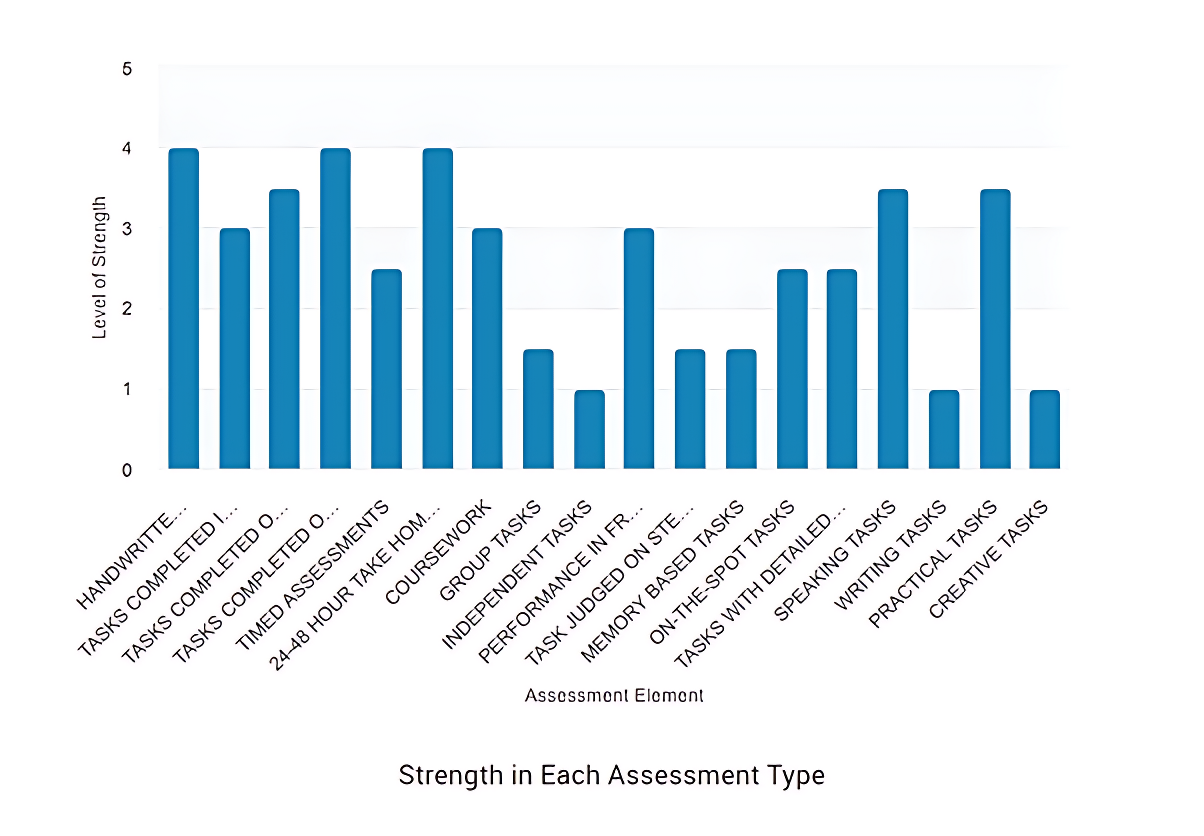
Your profile includes
- A comparison of your level of strength in each assessment element and your motivation to pursue this element
- In-depth information about your relationship to each assessment element
Filling in the tool – Considerations when selecting assessment elements
The tool supports you to think about four key aspects of your assessment experience to enable you to select which elements you wish to undertake.
- The support you need and the support available for each assessment element
The tool will ask you if there are supports that could help you with each assessment element – there will be some examples listed, but these are not exhaustive: feel free to get creative and think about all possible supports that could help you – this is not binding.
Then when you’re asked about whether you want to undertake an assessment element it’s time to get realistic – which supports do you think could realistically be provided for you if you ask? You may be surprised!
- Your current skill set in each assessment element
In addition to testing your “target skills” – the skills and knowledge the assessment is trying to assess, each assessment element will be associated with a specific “access skill” set. For instance timed assessments are associated with processing speed, prioritisation under pressure and stress management. These are rarely skills that your module lead is trying to assess and so it’s up to you if you want to be tested on them or choose a different assessment format.
The tool will first ask you questions about your level of strength in the skill set associated with an assessment element. These questions are designed to help you think about which elements work well for you and your existing skillset, so you can identify which formats let your knowledge shine through.
The tool will then ask you whether you want to undertake this assessment element. It’s important to remember that there’s no single “right” skill set. Everyone has different areas of strength and that’s a good thing.
- Whether an assessment element comes naturally to you or is accessible to you
You may feel less confident about some assessment elements because you haven’t tried them before. Other elements you may find more challenging, not because you haven’t tried, but because of how your brain works, your lived experience, or the environment around you.
That’s okay – you don’t have to force yourself to master the exact same elements and skills as the people around you. The tool supports you to think about your potential to do well in each assessment element, and how much effort this would require.
Some elements, you might find work well for you, or only require practice. Other elements you might not be able to improve as much with practice because they aren’t accessible for you. For example:
- If you have a disability which causes difficulties with the motor skills required to hold a pen, handwritten assessments may be a poor way to demonstrate your knowledge, no matter how much you practice.
- If you have a brain that excels in high pressure environments but naturally struggles to organise time independently you may find that the amount of effort you’re having to put in to complete coursework is having an impact on your mental health. There may be times when you want to ease off on coursework and instead go for timed assessments – health comes first!
- If you think you could develop excellent public speaking skills with specialised therapy for your anxiety, but don’t have access to such therapy, speaking in front of an audience may not be the best way to show your knowledge right now.
Acknowledging that some assessment skills come easier to you than others does not mean deciding that you will never be able to improve these skills. It enables you to make decisions that will allow you to thrive in your current context.
- If there are skill sets you want to practice and whether you want to practice them in a high stakes context
Sometimes we can choose to undertake an assessment element, not because it’s currently the best way of demonstrating our subject knowledge and skills but because we feel motivated to improve the access skills associated with that assessment type.
It might be that these skills make up the day-to-day tasks of your preferred career, e.g. working under time pressure can be important in some medical specialisms. It might be a skill set you admire in others or think would be helpful in your personal life, e.g. practicing group work may help you become a better team player. Sometimes it can be easy to feel that the skills associated with “traditional” exams are the most important, however it’s worth considering whether these are really the skills that will be the most useful for you in your career or life.
Sometimes you will want to lean into your strengths to demonstrate what you’ve learned in your course to the best of your abilities. Other times you might want to practice specific access skills. Either choice is okay. Especially consider using formative assessment opportunities – assessments that do not count toward your final grade – to explore new assessment forms and practice skills you know you struggle with.
Deciding whether you want to undertake a type of assessment is personal to you, and you can always revisit those choices as you progress in your studies. Feel free to use this tool again if you do!
How You Can Use the Results
The information in your profile is there to help you understand your skills and preferences in assessment formats and to make informed decisions about assessments – you can do this on your own, or in discussion with friends or staff members.
A 15 minute survey cannot cover all possible considerations. For each element the outputs contain a section where you can add any thoughts or reflections. For example, you might want to reflect on:
- Skills that the survey did not cover
- Your specific motivation for improving your skills in specific elements
- Different ways that elements might combine to make assessments that work really well for you.
Your profile is anonymous, and you do not have to share the profile with anyone. If you do share your results with people at your institution, you will not be penalised or expected to use a certain assessment format because of your results. Nor will you be guaranteed a certain assessment format. The tool is just a starting point.
Your skills, motivations, supports and preferences will change as you grow. If, for any reason, you want to generate a different profile, you can fill in the survey again.
Choosing an Assessment
If your module is offering multiple assessment formats, your profile can help you decide between them by identifying the different elements in each assessment format being offered, and compare to your results. Most assessments will have some elements that you feel confident in and some elements that you feel less confident in, creating opportunities for growth.
If none of the assessments being offered feel accessible to you, it is almost always possible to change an assessment element without losing academic rigour. Speak to your module lead.
Discussing Support and Disability
You might want to share the profile to discuss your support needs with friends, or staff members like your course/module organisers, personal tutor, or disability and wellbeing services staff.
If you find that certain assessment elements are very difficult for you, you may question whether this is due to a disability To have a disability is to have a long term “difference” or “impairment” which (in your social context) has a substantial impact on your ability to do normal every-day activities like reading large amounts of text, concentrating, socialising, taking notes, or doing the dishes. Disabilities include long term conditions such as chronic illnesses, mental health conditions and neurodiversity. Disabled students are entitled to reasonable adjustment when it comes to assessments. If you’re wondering if you have a disability you might want to discuss this with your personal tutor or disability services to ensure that appropriate support is put in place.
Example Student Profiles
Jamie – The Hands-On Creator
Jamie thinks best when doing something practical. They excel in projects where they can design, build, or experiment, and often struggle to sit still and write long essays.The tool shows that they have the following profile:
- Strengths: Practical assessment, creative assessment, solo assessments
- Supports and Strategies: They would benefit from taking frequent breaks during timed assessments and help structuring their time in coursework.
- How they work: Practical and spoken assessments feel most natural for their brain, while timed assessments feel stressful and don’t bring out their best work.
- Motivation: Jamie wants to become a programmer and sees practical assessment as most similar to the kind of work they’ll take on in their career. They also want to strengthen their social skills, which they’re not yet confident in.
When given a choice of assessment Jamie chooses practical assessments. For assessments that don’t count as much toward their final grade they also choose to strengthen their social skills through group work.
After completing the tool Jamie wonders if their difficulties may fit an ADHD profile but due to conditions of their visa they decide not to pursue a diagnosis, instead they speak to their module lead about support and she offers for them to take exam breaks in case they ever have to undertake timed assessments.
Joseph – The Researcher
Joseph is well rounded and does well in both memory based assessment and coursework. However he enjoys coursework more as he is able to show the depth of his knowledge and construct original arguments. The tool shows that he has the following profile:
- Strengths: Coursework, memory based assessment, assessments with clear instructions
- How he works: While he scores well in memory based assessment Joseph finds he has to work harder at them. He finds most enjoyment in coursework, where he can use evidence fully.
- Supports and Strategies: A room of his own or noise cancelling headphones.
- Motivation: Joseph wants to work in research. He knows that sometimes he’ll need to think quickly, like when answering questions after a lecture, and other times he’ll have months to refine ideas for journal articles or books. Since he already works well under pressure, he doesn’t feel the need to practise timed assessments.
For most of his assessments, Joseph leans into what he enjoys and chooses coursework. To prepare for academic life, he also chooses some presentations. He decides these should count toward his final grade to build motivation and allow him to experience the same kind of healthy stress he’ll face when delivering conference papers.
Joseph asks his university for noise cancelling headphones to allow him to really focus on coursework despite not having a room of his own
Aisha – The Reflective Writer
Aisha enjoys writing and often finds it the easiest way to organise her thoughts. She feels confident when she can take her time to think and edit her ideas, The tool shows that she has the following profile:
- Strengths: Writing tasks, group tasks, tasks judged on step by step structure, coursework
- How she works: Aisha finds that written coursework feels the most natural to her. She experiences severe anxiety symptoms during assessments in front of an audience, significantly impacting on her health. Group tasks work well for her as long as they are not presented through speaking.
- Supports and Strategies: Aisha recognises that having a smaller audience and extra thinking time during on-the spot assessment helps somewhat but does not completely fix the issue. She would like counseling to work on her anxiety long term.
- Motivation: Aisha wishes to become a writer and is motivated to further improve her writing skills. While interested in developing her speaking in front of an audience long term Aisha has a lot going on right now and does not want to prioritise tackling her speaking anxiety through assessment.
When given a choice of assessment, Aisha chooses written assessments in line with her career goal. She takes on group work when the output is in writing, but doesn’t push herself to match others who find speaking effortless.
Realising that her level of anxiety is unusual, Aisha talks to the university counseling services who diagnose her with social anxiety and provide counseling.